| Record Information |
|---|
| Version | 5.0 |
|---|
| Status | Detected but not Quantified |
|---|
| Creation Date | 2021-09-11 07:53:00 UTC |
|---|
| Update Date | 2021-09-26 23:02:25 UTC |
|---|
| HMDB ID | HMDB0250777 |
|---|
| Secondary Accession Numbers | None |
|---|
| Metabolite Identification |
|---|
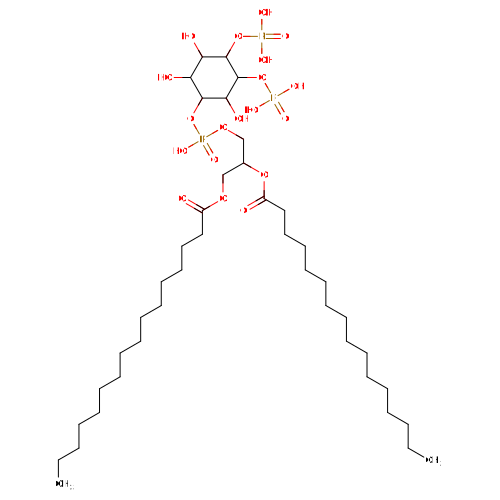
| Common Name | 1,2-Dihexadecanoyl-sn-glycero-3-phospho-(1D-myo-inositol-3,4-bisphosphate) |
|---|
| Description | 1,2-Dihexadecanoyl-sn-glycero-3-phospho-(1D-myo-inositol-3,4-bisphosphate) belongs to the class of organic compounds known as phosphatidylinositol-4,5-bisphosphates. These are phosphatidylinositol bisphosphates in which the two phosphate groups are at C-4 and C-5 of the inositol moiety. Based on a literature review very few articles have been published on 1,2-Dihexadecanoyl-sn-glycero-3-phospho-(1D-myo-inositol-3,4-bisphosphate). This compound has been identified in human blood as reported by (PMID: 31557052 ). 1,2-dihexadecanoyl-sn-glycero-3-phospho-(1d-myo-inositol-3,4-bisphosphate) is not a naturally occurring metabolite and is only found in those individuals exposed to this compound or its derivatives. Technically 1,2-Dihexadecanoyl-sn-glycero-3-phospho-(1D-myo-inositol-3,4-bisphosphate) is part of the human exposome. The exposome can be defined as the collection of all the exposures of an individual in a lifetime and how those exposures relate to health. An individual's exposure begins before birth and includes insults from environmental and occupational sources. |
|---|
| Structure | CCCCCCCCCCCCCCCC(=O)OCC(COP(O)(=O)OC1C(O)C(O)C(OP(O)(O)=O)C(OP(O)(O)=O)C1O)OC(=O)CCCCCCCCCCCCCCC InChI=1S/C41H81O19P3/c1-3-5-7-9-11-13-15-17-19-21-23-25-27-29-34(42)55-31-33(57-35(43)30-28-26-24-22-20-18-16-14-12-10-8-6-4-2)32-56-63(53,54)60-39-36(44)37(45)40(58-61(47,48)49)41(38(39)46)59-62(50,51)52/h33,36-41,44-46H,3-32H2,1-2H3,(H,53,54)(H2,47,48,49)(H2,50,51,52) |
|---|
| Synonyms | | Value | Source |
|---|
| 1,2-Dihexadecanoyl-sn-glycero-3-phospho-(1D-myo-inositol-3,4-bisphosphoric acid) | Generator |
|
|---|
| Chemical Formula | C41H81O19P3 |
|---|
| Average Molecular Weight | 971.001 |
|---|
| Monoisotopic Molecular Weight | 970.458491382 |
|---|
| IUPAC Name | {[4-({[2,3-bis(hexadecanoyloxy)propoxy](hydroxy)phosphoryl}oxy)-2,3,5-trihydroxy-6-(phosphonooxy)cyclohexyl]oxy}phosphonic acid |
|---|
| Traditional Name | (4-{[2,3-bis(hexadecanoyloxy)propoxy(hydroxy)phosphoryl]oxy}-2,3,5-trihydroxy-6-(phosphonooxy)cyclohexyl)oxyphosphonic acid |
|---|
| CAS Registry Number | Not Available |
|---|
| SMILES | CCCCCCCCCCCCCCCC(=O)OCC(COP(O)(=O)OC1C(O)C(O)C(OP(O)(O)=O)C(OP(O)(O)=O)C1O)OC(=O)CCCCCCCCCCCCCCC |
|---|
| InChI Identifier | InChI=1S/C41H81O19P3/c1-3-5-7-9-11-13-15-17-19-21-23-25-27-29-34(42)55-31-33(57-35(43)30-28-26-24-22-20-18-16-14-12-10-8-6-4-2)32-56-63(53,54)60-39-36(44)37(45)40(58-61(47,48)49)41(38(39)46)59-62(50,51)52/h33,36-41,44-46H,3-32H2,1-2H3,(H,53,54)(H2,47,48,49)(H2,50,51,52) |
|---|
| InChI Key | HKWJHKSHEWVOSS-UHFFFAOYSA-N |
|---|
| Chemical Taxonomy |
|---|
| Description | Belongs to the class of organic compounds known as phosphatidylinositol-4,5-bisphosphates. These are phosphatidylinositol bisphosphates in which the two phosphate groups are at C-4 and C-5 of the inositol moiety. |
|---|
| Kingdom | Organic compounds |
|---|
| Super Class | Lipids and lipid-like molecules |
|---|
| Class | Glycerophospholipids |
|---|
| Sub Class | Glycerophosphoinositol phosphates |
|---|
| Direct Parent | Phosphatidylinositol-4,5-bisphosphates |
|---|
| Alternative Parents | |
|---|
| Substituents | - Diacylglycerophosphoinositol-4,5-bisphosphate
- Diacylglycerophosphoinositol
- Glycerophosphoinositol
- Inositol phosphate
- Cyclohexanol
- Fatty acid ester
- Dialkyl phosphate
- Monoalkyl phosphate
- Cyclitol or derivatives
- Dicarboxylic acid or derivatives
- Organic phosphoric acid derivative
- Phosphoric acid ester
- Fatty acyl
- Alkyl phosphate
- Cyclic alcohol
- Carboxylic acid ester
- Secondary alcohol
- Carboxylic acid derivative
- Polyol
- Alcohol
- Hydrocarbon derivative
- Organic oxide
- Organic oxygen compound
- Organooxygen compound
- Carbonyl group
- Aliphatic homomonocyclic compound
|
|---|
| Molecular Framework | Aliphatic homomonocyclic compounds |
|---|
| External Descriptors | Not Available |
|---|
| Ontology |
|---|
| Physiological effect | Not Available |
|---|
| Disposition | |
|---|
| Process | Not Available |
|---|
| Role | Not Available |
|---|
| Physical Properties |
|---|
| State | Not Available |
|---|
| Experimental Molecular Properties | | Property | Value | Reference |
|---|
| Melting Point | Not Available | Not Available | | Boiling Point | Not Available | Not Available | | Water Solubility | Not Available | Not Available | | LogP | Not Available | Not Available |
|
|---|
| Experimental Chromatographic Properties | Not Available |
|---|
| Predicted Molecular Properties | |
|---|
| Predicted Chromatographic Properties | Predicted Collision Cross SectionsPredicted Retention Times Underivatized| Chromatographic Method | Retention Time | Reference |
|---|
| Predicted by Siyang on May 30, 2022 | 17.6552 minutes | 33406817 | | Predicted by Siyang using ReTip algorithm on June 8, 2022 | 3.94 minutes | 32390414 | | Fem_Long = Waters ACQUITY UPLC HSS T3 C18 with Water:MeOH and 0.1% Formic Acid | 3540.0 seconds | 40023050 | | Fem_Lipids = Ascentis Express C18 with (60:40 water:ACN):(90:10 IPA:ACN) and 10mM NH4COOH + 0.1% Formic Acid | 129.9 seconds | 40023050 | | Life_Old = Waters ACQUITY UPLC BEH C18 with Water:(20:80 acetone:ACN) and 0.1% Formic Acid | 272.9 seconds | 40023050 | | Life_New = RP Waters ACQUITY UPLC HSS T3 C18 with Water:(30:70 MeOH:ACN) and 0.1% Formic Acid | 181.4 seconds | 40023050 | | RIKEN = Waters ACQUITY UPLC BEH C18 with Water:ACN and 0.1% Formic Acid | 661.5 seconds | 40023050 | | Eawag_XBridgeC18 = XBridge C18 3.5u 2.1x50 mm with Water:MeOH and 0.1% Formic Acid | 814.3 seconds | 40023050 | | BfG_NTS_RP1 =Agilent Zorbax Eclipse Plus C18 (2.1 mm x 150 mm, 3.5 um) with Water:ACN and 0.1% Formic Acid | 906.7 seconds | 40023050 | | HILIC_BDD_2 = Merck SeQuant ZIC-HILIC with ACN(0.1% formic acid):water(16 mM ammonium formate) | 1056.3 seconds | 40023050 | | UniToyama_Atlantis = RP Waters Atlantis T3 (2.1 x 150 mm, 5 um) with ACN:Water and 0.1% Formic Acid | 1650.0 seconds | 40023050 | | BDD_C18 = Hypersil Gold 1.9µm C18 with Water:ACN and 0.1% Formic Acid | 910.8 seconds | 40023050 | | UFZ_Phenomenex = Kinetex Core-Shell C18 2.6 um, 3.0 x 100 mm, Phenomenex with Water:MeOH and 0.1% Formic Acid | 1425.1 seconds | 40023050 | | SNU_RIKEN_POS = Waters ACQUITY UPLC BEH C18 with Water:ACN and 0.1% Formic Acid | 665.7 seconds | 40023050 | | RPMMFDA = Waters ACQUITY UPLC BEH C18 with Water:ACN and 0.1% Formic Acid | 573.2 seconds | 40023050 | | MTBLS87 = Merck SeQuant ZIC-pHILIC column with ACN:Water and :ammonium carbonate | 215.9 seconds | 40023050 | | KI_GIAR_zic_HILIC_pH2_7 = Merck SeQuant ZIC-HILIC with ACN:Water and 0.1% FA | 64.7 seconds | 40023050 | | Meister zic-pHILIC pH9.3 = Merck SeQuant ZIC-pHILIC column with ACN:Water 5mM NH4Ac pH9.3 and 5mM ammonium acetate in water | 138.5 seconds | 40023050 |
Predicted Kovats Retention IndicesNot Available |
|---|
| MS/MS Spectra| Spectrum Type | Description | Splash Key | Deposition Date | Source | View |
|---|
| Predicted LC-MS/MS | Predicted LC-MS/MS Spectrum - 1,2-Dihexadecanoyl-sn-glycero-3-phospho-(1D-myo-inositol-3,4-bisphosphate) 10V, Negative-QTOF | splash10-014i-0000000009-2cc20d0ef7e2d2460e8f | 2021-10-12 | Wishart Lab | View Spectrum | | Predicted LC-MS/MS | Predicted LC-MS/MS Spectrum - 1,2-Dihexadecanoyl-sn-glycero-3-phospho-(1D-myo-inositol-3,4-bisphosphate) 20V, Negative-QTOF | splash10-016r-8050302908-85caa460b0f672fa5dd1 | 2021-10-12 | Wishart Lab | View Spectrum | | Predicted LC-MS/MS | Predicted LC-MS/MS Spectrum - 1,2-Dihexadecanoyl-sn-glycero-3-phospho-(1D-myo-inositol-3,4-bisphosphate) 40V, Negative-QTOF | splash10-004i-9011000000-9b99706b4f28c481e149 | 2021-10-12 | Wishart Lab | View Spectrum | | Predicted LC-MS/MS | Predicted LC-MS/MS Spectrum - 1,2-Dihexadecanoyl-sn-glycero-3-phospho-(1D-myo-inositol-3,4-bisphosphate) 10V, Positive-QTOF | splash10-00di-2000020009-ac3c42396a065730ef49 | 2021-10-12 | Wishart Lab | View Spectrum | | Predicted LC-MS/MS | Predicted LC-MS/MS Spectrum - 1,2-Dihexadecanoyl-sn-glycero-3-phospho-(1D-myo-inositol-3,4-bisphosphate) 20V, Positive-QTOF | splash10-0uk9-9044252055-8f0472fa846b932e37a7 | 2021-10-12 | Wishart Lab | View Spectrum | | Predicted LC-MS/MS | Predicted LC-MS/MS Spectrum - 1,2-Dihexadecanoyl-sn-glycero-3-phospho-(1D-myo-inositol-3,4-bisphosphate) 40V, Positive-QTOF | splash10-0002-8194510100-08bfca2975ea7b5b3389 | 2021-10-12 | Wishart Lab | View Spectrum |
|
|---|