| Record Information |
|---|
| Version | 5.0 |
|---|
| Status | Expected but not Quantified |
|---|
| Creation Date | 2005-11-16 15:48:42 UTC |
|---|
| Update Date | 2022-03-07 02:49:08 UTC |
|---|
| HMDB ID | HMDB0001113 |
|---|
| Secondary Accession Numbers | |
|---|
| Metabolite Identification |
|---|
| Common Name | Isovaleryl-CoA |
|---|
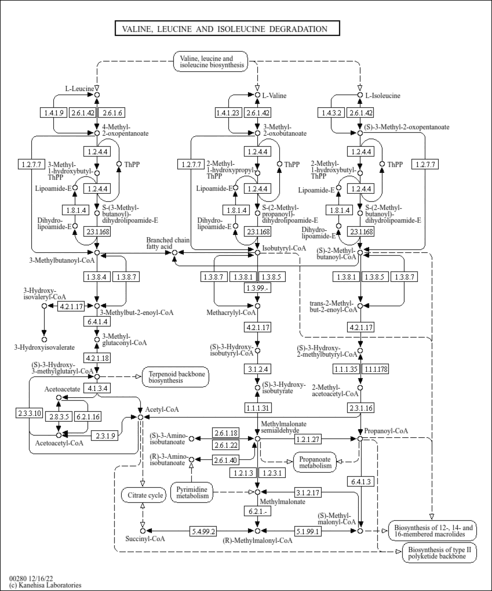
| Description | Isovaleryl-CoA is an intermediate metabolite in the catabolic pathway of leucine. The accumulation of derivatives of isovaleryl-CoA occurs in patients affected with isovaleric acidemia (IVA, OMIM: 243500 ), an autosomal recessive inborn error of leucine metabolism caused by a deficiency of the mitochondrial enzyme isovaleryl-CoA dehydrogenase (IVD, EC 1.3.99.10), a flavoenzyme that catalyzes the conversion of isovaleryl-CoA into 3-methylcrotonyl-CoA. IVA was the first organic acidemia recognized in humans and can cause significant morbidity and mortality. Early diagnosis and treatment with a protein-restricted diet and supplementation with carnitine and glycine are effective in promoting normal development in severely affected individuals. Both intra- and interfamilial variability have been recognized. Initially, two phenotypes with either an acute neonatal or a chronic intermittent presentation were described. More recently, a third group of individuals with mild biochemical abnormalities who can be asymptomatic have been identified through newborn screening of blood spots by tandem mass spectrometry. The majority of patients with IVA today are diagnosed pre-symptomatically through newborn screening by use of MS/MS which reveals elevations of the marker metabolite C5 acylcarnitine in dried blood spots. C5 Acylcarnitine represents a mixture of isomers (isovalerylcarnitine, 2-methylbutyrylcarnitine, and pivaloylcarnitine) (PMID: 16602101 ). |
|---|
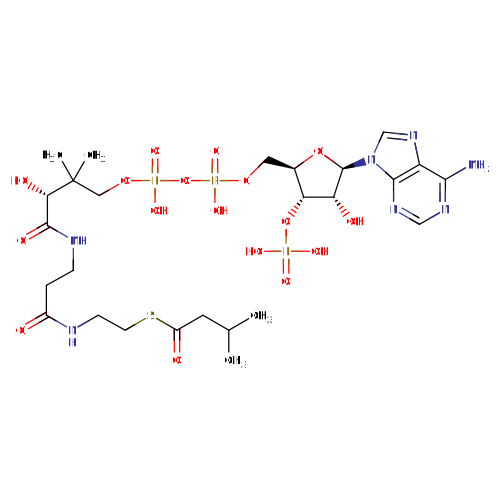
| Structure | CC(C)CC(=O)SCCNC(=O)CCNC(=O)[C@H](O)C(C)(C)COP(O)(=O)OP(O)(=O)OC[C@H]1O[C@H]([C@H](O)[C@@H]1OP(O)(O)=O)N1C=NC2=C1N=CN=C2N InChI=1S/C26H44N7O17P3S/c1-14(2)9-17(35)54-8-7-28-16(34)5-6-29-24(38)21(37)26(3,4)11-47-53(44,45)50-52(42,43)46-10-15-20(49-51(39,40)41)19(36)25(48-15)33-13-32-18-22(27)30-12-31-23(18)33/h12-15,19-21,25,36-37H,5-11H2,1-4H3,(H,28,34)(H,29,38)(H,42,43)(H,44,45)(H2,27,30,31)(H2,39,40,41)/t15-,19-,20-,21+,25-/m1/s1 |
|---|
| Synonyms | | Value | Source |
|---|
| 3-Methylbutanoyl-CoA | ChEBI | | 3-Methylbutanoyl-coenzyme A | ChEBI | | 3-Methylbutyryl-CoA | ChEBI | | 3-Methylbutyryl-coenzyme A | ChEBI | | beta-Methylbutanoyl-CoA | ChEBI | | beta-Methylbutanoyl-coenzyme A | ChEBI | | beta-Methylbutyryl-CoA | ChEBI | | beta-Methylbutyryl-coenzyme A | ChEBI | | Isovaleryl-coenzyme A | ChEBI | | b-Methylbutanoyl-CoA | Generator | | Β-methylbutanoyl-CoA | Generator | | b-Methylbutanoyl-coenzyme A | Generator | | Β-methylbutanoyl-coenzyme A | Generator | | b-Methylbutyryl-CoA | Generator | | Β-methylbutyryl-CoA | Generator | | b-Methylbutyryl-coenzyme A | Generator | | Β-methylbutyryl-coenzyme A | Generator | | Isovaleryl coenzyme A | HMDB | | Isovaleryl-CoA | HMDB |
|
|---|
| Chemical Formula | C26H44N7O17P3S |
|---|
| Average Molecular Weight | 851.651 |
|---|
| Monoisotopic Molecular Weight | 851.172723243 |
|---|
| IUPAC Name | (2R)-4-({[({[(2R,3S,4R,5R)-5-(6-amino-9H-purin-9-yl)-4-hydroxy-3-(phosphonooxy)oxolan-2-yl]methoxy}(hydroxy)phosphoryl)oxy](hydroxy)phosphoryl}oxy)-2-hydroxy-3,3-dimethyl-N-[2-({2-[(3-methylbutanoyl)sulfanyl]ethyl}-C-hydroxycarbonimidoyl)ethyl]butanimidic acid |
|---|
| Traditional Name | (2R)-4-[({[(2R,3S,4R,5R)-5-(6-aminopurin-9-yl)-4-hydroxy-3-(phosphonooxy)oxolan-2-yl]methoxy(hydroxy)phosphoryl}oxy(hydroxy)phosphoryl)oxy]-2-hydroxy-3,3-dimethyl-N-[2-({2-[(3-methylbutanoyl)sulfanyl]ethyl}-C-hydroxycarbonimidoyl)ethyl]butanimidic acid |
|---|
| CAS Registry Number | 6244-91-3 |
|---|
| SMILES | CC(C)CC(=O)SCCNC(=O)CCNC(=O)[C@H](O)C(C)(C)COP(O)(=O)OP(O)(=O)OC[C@H]1O[C@H]([C@H](O)[C@@H]1OP(O)(O)=O)N1C=NC2=C1N=CN=C2N |
|---|
| InChI Identifier | InChI=1S/C26H44N7O17P3S/c1-14(2)9-17(35)54-8-7-28-16(34)5-6-29-24(38)21(37)26(3,4)11-47-53(44,45)50-52(42,43)46-10-15-20(49-51(39,40)41)19(36)25(48-15)33-13-32-18-22(27)30-12-31-23(18)33/h12-15,19-21,25,36-37H,5-11H2,1-4H3,(H,28,34)(H,29,38)(H,42,43)(H,44,45)(H2,27,30,31)(H2,39,40,41)/t15-,19-,20-,21+,25-/m1/s1 |
|---|
| InChI Key | UYVZIWWBJMYRCD-ZMHDXICWSA-N |
|---|
| Chemical Taxonomy |
|---|
| Description | Belongs to the class of organic compounds known as acyl coas. These are organic compounds containing a coenzyme A substructure linked to an acyl chain. |
|---|
| Kingdom | Organic compounds |
|---|
| Super Class | Lipids and lipid-like molecules |
|---|
| Class | Fatty Acyls |
|---|
| Sub Class | Fatty acyl thioesters |
|---|
| Direct Parent | Acyl CoAs |
|---|
| Alternative Parents | |
|---|
| Substituents | - Coenzyme a or derivatives
- Purine ribonucleoside 3',5'-bisphosphate
- Purine ribonucleoside bisphosphate
- Purine ribonucleoside diphosphate
- Ribonucleoside 3'-phosphate
- Pentose phosphate
- Pentose-5-phosphate
- Beta amino acid or derivatives
- Glycosyl compound
- N-glycosyl compound
- 6-aminopurine
- Monosaccharide phosphate
- Organic pyrophosphate
- Pentose monosaccharide
- Imidazopyrimidine
- Purine
- Monoalkyl phosphate
- Aminopyrimidine
- Imidolactam
- N-acyl-amine
- N-substituted imidazole
- Organic phosphoric acid derivative
- Monosaccharide
- Pyrimidine
- Alkyl phosphate
- Fatty amide
- Phosphoric acid ester
- Tetrahydrofuran
- Imidazole
- Azole
- Heteroaromatic compound
- Carbothioic s-ester
- Secondary alcohol
- Thiocarboxylic acid ester
- Carboxamide group
- Secondary carboxylic acid amide
- Amino acid or derivatives
- Sulfenyl compound
- Thiocarboxylic acid or derivatives
- Organoheterocyclic compound
- Azacycle
- Oxacycle
- Carboxylic acid derivative
- Organosulfur compound
- Organic oxygen compound
- Hydrocarbon derivative
- Carbonyl group
- Organic nitrogen compound
- Primary amine
- Organopnictogen compound
- Organic oxide
- Organooxygen compound
- Organonitrogen compound
- Alcohol
- Amine
- Aromatic heteropolycyclic compound
|
|---|
| Molecular Framework | Aromatic heteropolycyclic compounds |
|---|
| External Descriptors | |
|---|
| Ontology |
|---|
| Not Available | Not Available |
|---|
| Physical Properties |
|---|
| State | Solid |
|---|
| Experimental Molecular Properties | | Property | Value | Reference |
|---|
| Melting Point | Not Available | Not Available | | Boiling Point | Not Available | Not Available | | Water Solubility | Not Available | Not Available | | LogP | Not Available | Not Available |
|
|---|
| Experimental Chromatographic Properties | Not Available |
|---|
| Predicted Molecular Properties | |
|---|
| Predicted Chromatographic Properties | Predicted Collision Cross SectionsPredicted Retention Times Underivatized| Chromatographic Method | Retention Time | Reference |
|---|
| Measured using a Waters Acquity ultraperformance liquid chromatography (UPLC) ethylene-bridged hybrid (BEH) C18 column (100 mm × 2.1 mm; 1.7 μmparticle diameter). Predicted by Afia on May 17, 2022. Predicted by Afia on May 17, 2022. | 3.63 minutes | 32390414 | | Predicted by Siyang on May 30, 2022 | 10.1919 minutes | 33406817 | | Predicted by Siyang using ReTip algorithm on June 8, 2022 | 9.3 minutes | 32390414 | | AjsUoB = Accucore 150 Amide HILIC with 10mM Ammonium Formate, 0.1% Formic Acid | 489.4 seconds | 40023050 | | Fem_Long = Waters ACQUITY UPLC HSS T3 C18 with Water:MeOH and 0.1% Formic Acid | 1324.6 seconds | 40023050 | | Fem_Lipids = Ascentis Express C18 with (60:40 water:ACN):(90:10 IPA:ACN) and 10mM NH4COOH + 0.1% Formic Acid | 155.6 seconds | 40023050 | | Life_Old = Waters ACQUITY UPLC BEH C18 with Water:(20:80 acetone:ACN) and 0.1% Formic Acid | 106.5 seconds | 40023050 | | Life_New = RP Waters ACQUITY UPLC HSS T3 C18 with Water:(30:70 MeOH:ACN) and 0.1% Formic Acid | 157.8 seconds | 40023050 | | RIKEN = Waters ACQUITY UPLC BEH C18 with Water:ACN and 0.1% Formic Acid | 83.3 seconds | 40023050 | | Eawag_XBridgeC18 = XBridge C18 3.5u 2.1x50 mm with Water:MeOH and 0.1% Formic Acid | 372.5 seconds | 40023050 | | BfG_NTS_RP1 =Agilent Zorbax Eclipse Plus C18 (2.1 mm x 150 mm, 3.5 um) with Water:ACN and 0.1% Formic Acid | 440.0 seconds | 40023050 | | HILIC_BDD_2 = Merck SeQuant ZIC-HILIC with ACN(0.1% formic acid):water(16 mM ammonium formate) | 782.7 seconds | 40023050 | | UniToyama_Atlantis = RP Waters Atlantis T3 (2.1 x 150 mm, 5 um) with ACN:Water and 0.1% Formic Acid | 665.8 seconds | 40023050 | | BDD_C18 = Hypersil Gold 1.9µm C18 with Water:ACN and 0.1% Formic Acid | 376.7 seconds | 40023050 | | UFZ_Phenomenex = Kinetex Core-Shell C18 2.6 um, 3.0 x 100 mm, Phenomenex with Water:MeOH and 0.1% Formic Acid | 688.0 seconds | 40023050 | | SNU_RIKEN_POS = Waters ACQUITY UPLC BEH C18 with Water:ACN and 0.1% Formic Acid | 224.5 seconds | 40023050 | | RPMMFDA = Waters ACQUITY UPLC BEH C18 with Water:ACN and 0.1% Formic Acid | 213.0 seconds | 40023050 | | MTBLS87 = Merck SeQuant ZIC-pHILIC column with ACN:Water and :ammonium carbonate | 414.1 seconds | 40023050 | | KI_GIAR_zic_HILIC_pH2_7 = Merck SeQuant ZIC-HILIC with ACN:Water and 0.1% FA | 298.5 seconds | 40023050 | | Meister zic-pHILIC pH9.3 = Merck SeQuant ZIC-pHILIC column with ACN:Water 5mM NH4Ac pH9.3 and 5mM ammonium acetate in water | 356.1 seconds | 40023050 |
Predicted Kovats Retention IndicesUnderivatized |
|---|